

Browse Research
With 25+ years' experience evaluating, comparing, and recommending software, our expert analysis and verified user data combine for a uniquely trustworthy perspective on enterprise software.
Latest Research
Your Security Tools Were Built for People. Agents Are Not People.
Cisco spent the last 18 months acquiring its way into AI security, and at the April 2026 analyst briefing, the full picture came together. Cisco is presenting an end-to-end story for a question that many have not yet considered: What happens when the entity accessing your systems is not a person?
Big 5 AI Vendor Roundup: Week of May 4, 2026
It has become almost a full-time job to stay current with the glut of news in the AI space. This weekly roundup will get you up to speed on the news and happenings with the Big 5 AI vendors in the last week.
Anthropic’s “The Briefing: Financial Services” Event Was Different in the Best Way
On May 5, Dario Amodei and Jamie Dimon shared a stage in lower Manhattan to talk about AI in financial services. At first glance it looked like a standard vendor and customer keynote or panel-type discussion. It was much more than that.
Chata.ai: Deterministic AI That Does Not Lie
Deterministic AI offers a new option that falls between “manually” made reporting and analytics and LLM-based solutions prone to hallucinations.
Big 5 AI Vendor Roundup: Week of April 27, 2026
It has become almost a full-time job to stay current with the glut of news in the AI space. This weekly roundup will get you up to speed on the news and happenings with the Big 5 AI vendors in the last week.
AWS Doubles Down on Agentic AI in “What’s Next” Event
At its “What's Next With AWS” livestream event on April 28, 2026, AWS made three significant announcements that solidify its intent to expand from its foundation as an AI infrastructure provider to a full stack provider, including an AI application and agent platform.
Google Cloud Next 2026: It's All About the Agents
Google Cloud Next ‘26 in Las Vegas wrapped recently, and the theme was familiar. If 2025 was the year of experimenting with agentic AI, 2026 will be the year of running it at scale.
Big 5 AI Vendor Roundup: Week of April 20, 2026
It has become almost a full-time job to stay current with the glut of news in the AI space. This weekly roundup will get you up to speed on the news and happenings with the Big 5 AI vendors in the last week.
Adobe Targets the Next Phase of Customer Experience: Humans and AI Agents
Adobe introduced CX Enterprise as an agentic AI platform designed to help brands create content, improve visibility in AI-driven discovery, and orchestrate personalized engagement.

ServiceNow Bundles AI Into Every Product and Bets That Context Is the Missing Piece
We keep hearing that enterprise AI spending is up in many organizations, and the results are not remarkable. On April 9, 2026, ServiceNow announced it will no longer sell AI as an add-on, instead restructuring its commercial model to focus on AI and launching new features that let AI agents make organizational decisions without frequent human oversight.
From Digital Maturity to AI Value: An Interview With Zoho’s Ram Ramamoorthy
At ZohoDay26, Info-Tech’s John Annand sat down with Ramprakash “Ram” Ramamoorthy (Director of AI Research at Zoho). Over a wide-ranging conversation, John and Ram discussed Zoho’s go-to-market strategy for AI capabilities. This note provides a structured summary of that interview.
ManageEngine Is Quietly Rebuilding the Enterprise IT Control Plane
Rajesh Ganeshan didn’t walk on stage at the recent ZohoDay (February 2026) to announce a new product or declare a category shift. He spent the time doing something more unusual in enterprise software: explaining why ManageEngine exists the way it does, and why that history suddenly matters again.

Big 5 AI Vendor Roundup: Week of May 4, 2026
It has become almost a full-time job to stay current with the glut of news in the AI space. This weekly roundup will get you up to speed on the news and happenings with the Big 5 AI vendors in the last week.
Anthropic’s “The Briefing: Financial Services” Event Was Different in the Best Way
On May 5, Dario Amodei and Jamie Dimon shared a stage in lower Manhattan to talk about AI in financial services. At first glance it looked like a standard vendor and customer keynote or panel-type discussion. It was much more than that.
Big 5 AI Vendor Roundup: Week of April 27, 2026
It has become almost a full-time job to stay current with the glut of news in the AI space. This weekly roundup will get you up to speed on the news and happenings with the Big 5 AI vendors in the last week.

Finastra Launches Securities Financing Transaction Regulation Support
Finastra launches securities financing transaction regulation (SFTR) support ahead of the European Union’s April 11, 2020 deadline.
Three Global Banks Sign Up for Finastra’s Blockchain-Based LenderComm
Three global banks launched a blockchain-based platform to bring the promise of open ledgers and contracts to the loan management market.
Feeling Insecure at Wolters Kluwer After Security Breach
Wolters Kluwer suffers security breach after poor security management.

Zoho Announces Major Updates to Billing and Spend Solutions for the Enterprise
In an analyst briefing, Zoho provided updates to Zia's capabilities for finance use cases. Specifically, Zoho emphasized reconciliation, reporting, and proactive insights, with a showcase of its new enterprise billing and spend management products.
Integration Capabilities Will Drive Restaurant Operators’ Selection of Restaurant Manager’s POS System
POS system purchases are being driven by ease of integration. Identified as having the most satisfying of all POS systems when it comes to integration, Restaurant Manager displays that it understands the needs of restaurant operators.
Silverware POS Unveils Contactless Phone-to-Table Guest Dining Experiences
As pick-up/takeout has been the only operating option for restaurants for the last few months, Silverware’s release of its “In-Seat Contactless Platform” will assist COVID-19 “new normal” restaurants to deploy mobile-first, phone-to-table contactless features that were once a convenience but are now features of necessity.

Cognigy 2026: Agentic AI for Outstanding Customer Care and Proactive Resolution Takes Center Stage
Cognigy Nexus 2026 was held recently in Munich. The event highlighted a meaningful shift in the agentic market for AI-powered customer service, with NiCE focusing less on the novelty of agentic AI and more on the disciplines required to run it effectively at scale (such as governance, interoperability, and platform-driven approach). Its announcements around automation discovery from interaction data, multivariate testing, multimodal orchestration, and MCP-based interoperability suggest NiCE Cognigy is aligning with what enterprise buyers increasingly need: a way to identify the right use cases, test agents rigorously, connect them across journeys and systems, and manage them as part of an operating model rather than a standalone tool. The strategy is directionally strong, but its real value will depend on whether Cognigy can translate these capabilities into repeatable customer outcomes – and whether use cases can scale not just from customer care, but also to sales and marketing.
Has the “SaaSpocalypse” Come for CX Technology Providers?
This note examines whether “SaaSpocalypse” claims are valid, based on full-year results from 24 public companies that have significant customer experience (CX) SaaS offerings.
NiCE Unveils Vision for a CX-Powered Contact Center of the Future
NiCE is positioning its CXone Mpower as a platform intended to help contact centers shift from cost centers into growth engines by using customer interaction data as enterprise intelligence.

How to Stop Leaving Software CapEx on the Table With Agile and DevOps
Traditional accounting practices are tailor made for waterfall project management. Organizations that have transitioned to the use of standing product teams using Agile and DevOps need to transform their accounting practices as well or they will leave valuable capital expenditure dollars on the table.
Scaling Agile – Essential for Your Organization
So you’ve gone Agile. You do daily scrums, retrospectives, and all the “right” Agile ceremonies. But still your organization isn’t quite convinced. It is now critical to balance the drivers and goals of both Agile and traditional thinking in order to achieve organizational success.
Scrum Destroyed the Product Owner Role
When trying to implement Agile as a defined process, Scrum turned BAs or other roles into order takers with the title “product owner.” This undermines the entire value proposition of product management.

Regulated AI Crosses Into Production Reality
LighthouseIQ, launched on January 21, 2026, by Lighthouse Global is an AI intelligence platform purpose-built for eDiscovery. Outputs have been accepted by the Department of Justice and Federal Trade Commission on second-request matters. That is a production threshold most AI vendors in this space have not yet been required to clear.
Conga Acquires PROS as Part of Rebrand and Expanded Commerce Coverage
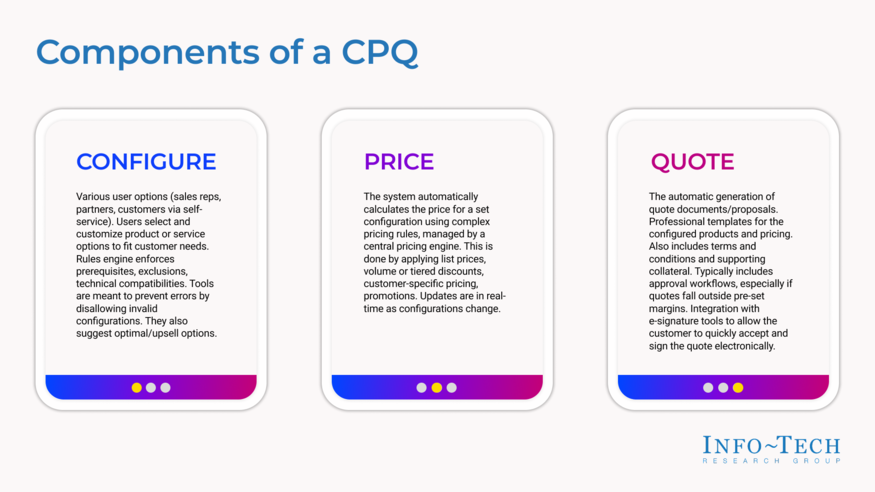
Big change is at hand for CPQ vendors Conga and PROS, as the former acquired the latter in early 2026. Catering to different markets, the two products will remain distinct within the Conga Advantage platform. Conga intends to provide robust functionality across the commerce chain by rounding out existing CLM, CPQ, and document generation capabilities with strong pricing technology and new AI capabilities.
From CPQ to Control Plane: How Conga Is Reassembling Enterprise Commerce
Conga is making a deliberate bid to become the control plane for enterprise commerce, not just a CPQ vendor with adjacent features. The PROS acquisition closes a structural pricing gap and accelerates Conga's AI roadmap, while the commerce chain narrative reframes how revenue work should flow end to end. If Conga executes well, it will be a default platform for complex enterprises. If it stumbles, it remains a strong but bounded CPQ incumbent.

Chata.ai: Deterministic AI That Does Not Lie
Deterministic AI offers a new option that falls between “manually” made reporting and analytics and LLM-based solutions prone to hallucinations.
Databricks Didn't Announce a Security Product. It Announced a Different Way to Think About Security Spending.
Databricks spent years as a quiet data infrastructure company. It did not chase security headlines. It built the platform where enterprise data lives. Databrick’s Lakewatch, launched in March 2026, is what happens when you stop treating security as a separate application and run it directly inside that platform instead. For existing Databricks customers, this is not a new vendor decision. It is a question of whether the infrastructure they already own can replace a tool they are probably overpaying for.
IBM’s Smartest AI Infrastructure Move Since Red Hat
IBM's approximately $11-billion acquisition of Confluent is less about Apache Kafka itself and more about owning the enterprise-grade, real-time data layer that supports modern analytics and AI workloads. For organizations already running IBM platforms, this has meaningful architectural and commercial implications. For cloud-native organizations, the practical impact is narrower than the announcement suggests.

Can Data-Driven Student Retention Strategies Make an Impact?
Student retention, already a major concern at higher education institutions, is an even greater concern as students are unable to learn in person and on campus.
State of Major Education LMS Conferences in Wake of COVID-19
Some major LMS conference cancellations or online alternatives have been announced in an attempt to limit the spread of COVID-19, though not all have canceled.
Online Learning Rises in Response to COVID-19
As the world responds to the spread of the novel coronavirus COVID-19, closed schools in some affected areas are turning to eLearning and web conferencing to maintain continuity in course delivery and/or studying.

ServiceNow Bundles AI Into Every Product and Bets That Context Is the Missing Piece
We keep hearing that enterprise AI spending is up in many organizations, and the results are not remarkable. On April 9, 2026, ServiceNow announced it will no longer sell AI as an add-on, instead restructuring its commercial model to focus on AI and launching new features that let AI agents make organizational decisions without frequent human oversight.
ServiceNow Makes Its Bid to Own Enterprise AI Execution
In a world where understanding of the power of AI is still confusing, ServiceNow has excellent messaging on what AI can actually achieve in an enterprise. Through TV ads and ads in the Wall Street Journal, the messaging has been clear: AI can assist and improve efficiency. With their recent announcement (February 2026) of two major launches – Autonomous Workforce and Employee Works – ServiceNow underscores the shift of AI from “answer engines” to “actually finishing the job.” With this announcement their message is clear: the era of AI experiments is over; AI operations at scale have begun. And ServiceNow wants to be the control tower that runs all of it.
ServiceNow Q4 Results Reinforce Enterprise AI Driving Business Impact
ServiceNow exceeds guidance as enterprise AI adoption accelerates growth, margin, and cash flow. Now Assist ACV tops $600M and heads toward a $1B run rate while customers commit at scale.

Winning on Deployment, Not Disruption: What Contract Logix CLM Actually Sells
Contract Logix, now part of LegalSifter, is a mid-market CLM platform that focuses on rapid deployment and operational simplicity, prioritizing usability and cost control over deep customization and advanced AI-driven contract intelligence.
Conga Acquires PROS as Part of Rebrand and Expanded Commerce Coverage
Big change is at hand for CPQ vendors Conga and PROS, as the former acquired the latter in early 2026. Catering to different markets, the two products will remain distinct within the Conga Advantage platform. Conga intends to provide robust functionality across the commerce chain by rounding out existing CLM, CPQ, and document generation capabilities with strong pricing technology and new AI capabilities.
From CPQ to Control Plane: How Conga Is Reassembling Enterprise Commerce
Conga is making a deliberate bid to become the control plane for enterprise commerce, not just a CPQ vendor with adjacent features. The PROS acquisition closes a structural pricing gap and accelerates Conga's AI roadmap, while the commerce chain narrative reframes how revenue work should flow end to end. If Conga executes well, it will be a default platform for complex enterprises. If it stumbles, it remains a strong but bounded CPQ incumbent.

Beyond Legacy Systems: How Verkada's Cloud Architecture Revolutionizes Physical Security
We examine Verkada's history, market position, and core offerings, providing an expert’s perspective informed by three decades of security architecture experience.
Data-Informed Decisions to Increase Revenue With IDeaS’ G3 Revenue Management System
IDeaS’ G3 revenue management solution will be highly sought after by properties looking to leverage data to make informed pricing decisions.
Bosch’s INTEOX positioned as “First Fully Open Camera Platform”
Bosch’s release of its INTEOX camera solution moves beyond the legacy “closed circuit” model of surveillance infrastructure to a Camera-as-a-Platform (CaaP) approach, enabling third-party apps at the surveillance perimeter edge to create innovative video-based business solutions and decisions.

Experian eCare NEXT Connects Revenue Cycle Management and Clinical Workflows
As the COVID-19 pandemic continues to evolve, healthcare organizations are looking for ways to expand digital patient care options. Patient management systems like Experian’s eCare NEXT help providers connect new digital clinical workflows to established workflows and revenue cycles.

Workday’s AI Bet Is Built on Data You Already Own
Workday has spent eighteen months acquiring the pieces – Sana Labs, Pipedream, Flowise – and the March 2026 global launch is where they converge. The result is an AI layer embedded directly in the system of record, capable of executing tasks, not just suggesting them. For HR and finance leaders in Workday shops, the embedded execution layer raises the bar for any team still considering a custom build.
Zoho Announces Major Updates to Billing and Spend Solutions for the Enterprise
In an analyst briefing, Zoho provided updates to Zia's capabilities for finance use cases. Specifically, Zoho emphasized reconciliation, reporting, and proactive insights, with a showcase of its new enterprise billing and spend management products.
The Newest at UKG: The Workforce Operating Platform
UKG, a leader in HR management systems, has introduced their Workforce Operating Platform. This platform unifies human capital management, workforce management, and payroll, coupled with its Bryte AI technology. The Workforce Operating Platform aims to help retail, manufacturing, and healthcare institutions manage complexity while simplifying and streamlining processes for frontline workers.

Big 5 AI Vendor Roundup: Week of May 4, 2026
It has become almost a full-time job to stay current with the glut of news in the AI space. This weekly roundup will get you up to speed on the news and happenings with the Big 5 AI vendors in the last week.
Big 5 AI Vendor Roundup: Week of April 27, 2026
It has become almost a full-time job to stay current with the glut of news in the AI space. This weekly roundup will get you up to speed on the news and happenings with the Big 5 AI vendors in the last week.
Google Cloud Next 2026: It's All About the Agents
Google Cloud Next ‘26 in Las Vegas wrapped recently, and the theme was familiar. If 2025 was the year of experimenting with agentic AI, 2026 will be the year of running it at scale.

Adobe Targets the Next Phase of Customer Experience: Humans and AI Agents
Adobe introduced CX Enterprise as an agentic AI platform designed to help brands create content, improve visibility in AI-driven discovery, and orchestrate personalized engagement.
ServiceNow Bundles AI Into Every Product and Bets That Context Is the Missing Piece
We keep hearing that enterprise AI spending is up in many organizations, and the results are not remarkable. On April 9, 2026, ServiceNow announced it will no longer sell AI as an add-on, instead restructuring its commercial model to focus on AI and launching new features that let AI agents make organizational decisions without frequent human oversight.
Conga Acquires PROS as Part of Rebrand and Expanded Commerce Coverage
Big change is at hand for CPQ vendors Conga and PROS, as the former acquired the latter in early 2026. Catering to different markets, the two products will remain distinct within the Conga Advantage platform. Conga intends to provide robust functionality across the commerce chain by rounding out existing CLM, CPQ, and document generation capabilities with strong pricing technology and new AI capabilities.

Your Security Tools Were Built for People. Agents Are Not People.
Cisco spent the last 18 months acquiring its way into AI security, and at the April 2026 analyst briefing, the full picture came together. Cisco is presenting an end-to-end story for a question that many have not yet considered: What happens when the entity accessing your systems is not a person?
Databricks Didn't Announce a Security Product. It Announced a Different Way to Think About Security Spending.
Databricks spent years as a quiet data infrastructure company. It did not chase security headlines. It built the platform where enterprise data lives. Databrick’s Lakewatch, launched in March 2026, is what happens when you stop treating security as a separate application and run it directly inside that platform instead. For existing Databricks customers, this is not a new vendor decision. It is a question of whether the infrastructure they already own can replace a tool they are probably overpaying for.
Palo Alto Networks: Securing the AI-Powered Enterprise – RSA 2026
Every so often something new comes along and becomes a nightmare for security professionals and a major impact on technology leaders, from the birth of email phishing and DDoS attacks to today, when anyone can create agents with outside software or within existing software.
Clio’s $1B Power Move: Legal Tech Enters Its AI Era
Clio, a leading global legal technology company based in Canada, has completed a $1 billion acquisition of vLex, a global legal intelligence platform. Simultaneously, Clio raised $500 million in Series G funding, bringing its valuation to $5 billion. This is considered one of the most significant transactions in legal tech history.
LexisNexis CounselLink+ Introduces AI to Enhance Its Legal Suite
LexisNexis has embedded its Protégé AI assistant into CounselLink+, enabling in-house legal teams to automate matter and invoice summarization, visualize spend and workload data, and access embedded legal content. The platform now combines AI efficiency, contract-to-matter linking, and deep integration with the LexisNexis ecosystem to streamline legal operations and support data-driven decision-making.

Adobe Targets the Next Phase of Customer Experience: Humans and AI Agents
Adobe introduced CX Enterprise as an agentic AI platform designed to help brands create content, improve visibility in AI-driven discovery, and orchestrate personalized engagement.
Conductor’s Shift to an AI Search Visibility Platform
Conductor has evolved beyond its traditional identity as an enterprise SEO platform and now positions itself as an AI search visibility and answer engine optimization (AEO) operating layer, reflecting the broader industry shift toward AI-mediated discovery. This repositioning emphasizes visibility across both search engines and AI-generated answer environments.
Medallia’s Experience ’26 Conference Advances AI-Driven Topic Modeling and Embedded Action Planning
Medallia’s Experience ’26 conference announced five voice-of-customer product capabilities, with emphasis on AI-driven topic modeling and embedded action planning. While Smart Topic Builder differentiates Medallia meaningfully, other announcements maintain feature parity.
ServiceNow Bundles AI Into Every Product and Bets That Context Is the Missing Piece
We keep hearing that enterprise AI spending is up in many organizations, and the results are not remarkable. On April 9, 2026, ServiceNow announced it will no longer sell AI as an add-on, instead restructuring its commercial model to focus on AI and launching new features that let AI agents make organizational decisions without frequent human oversight.
ServiceNow Makes Its Bid to Own Enterprise AI Execution
In a world where understanding of the power of AI is still confusing, ServiceNow has excellent messaging on what AI can actually achieve in an enterprise. Through TV ads and ads in the Wall Street Journal, the messaging has been clear: AI can assist and improve efficiency. With their recent announcement (February 2026) of two major launches – Autonomous Workforce and Employee Works – ServiceNow underscores the shift of AI from “answer engines” to “actually finishing the job.” With this announcement their message is clear: the era of AI experiments is over; AI operations at scale have begun. And ServiceNow wants to be the control tower that runs all of it.
ServiceNow Q4 Results Reinforce Enterprise AI Driving Business Impact
ServiceNow exceeds guidance as enterprise AI adoption accelerates growth, margin, and cash flow. Now Assist ACV tops $600M and heads toward a $1B run rate while customers commit at scale.

ServiceNow Bundles AI Into Every Product and Bets That Context Is the Missing Piece
We keep hearing that enterprise AI spending is up in many organizations, and the results are not remarkable. On April 9, 2026, ServiceNow announced it will no longer sell AI as an add-on, instead restructuring its commercial model to focus on AI and launching new features that let AI agents make organizational decisions without frequent human oversight.
ServiceNow Makes Its Bid to Own Enterprise AI Execution
In a world where understanding of the power of AI is still confusing, ServiceNow has excellent messaging on what AI can actually achieve in an enterprise. Through TV ads and ads in the Wall Street Journal, the messaging has been clear: AI can assist and improve efficiency. With their recent announcement (February 2026) of two major launches – Autonomous Workforce and Employee Works – ServiceNow underscores the shift of AI from “answer engines” to “actually finishing the job.” With this announcement their message is clear: the era of AI experiments is over; AI operations at scale have begun. And ServiceNow wants to be the control tower that runs all of it.
ServiceNow Q4 Results Reinforce Enterprise AI Driving Business Impact
ServiceNow exceeds guidance as enterprise AI adoption accelerates growth, margin, and cash flow. Now Assist ACV tops $600M and heads toward a $1B run rate while customers commit at scale.
ServiceNow Bundles AI Into Every Product and Bets That Context Is the Missing Piece
We keep hearing that enterprise AI spending is up in many organizations, and the results are not remarkable. On April 9, 2026, ServiceNow announced it will no longer sell AI as an add-on, instead restructuring its commercial model to focus on AI and launching new features that let AI agents make organizational decisions without frequent human oversight.
Salesforce Advances Intelligent Document Processing With Flow
Salesforce is working toward a future where humans, systems, and agents are positioned together to get work done. Within this framework, Salesforce is adding flow-native Intelligent Document Processing (IDP) to their MuleSoft offering. This builds on optical character recognition (OCR) by using AI to classify documents, extract key fields, and route structured data into workflows.
Asana Goes Beyond Tasks: A Work Graph–Powered AI Offensive
Asana has introduced new AI features aimed at expanding its work management platform with agent‑driven automation. The core capability, AI Teammates, enables AI to directly support task execution, content creation, and workflow progression rather than serving only as a passive assistant. These capabilities are most beneficial for organizations that already maintain structured, consistent usage of Asana across teams.

Can OfficeSpace Break Real Estate’s Resistance to Modernization?
OfficeSpace Software is repositioning itself as an AI operating system for the built world, backed not by generic LLM wrappers but by domain‑specific models through their acquisition of Dojo. These models automate high‑value workflows such as restacks, occupancy forecasting, adjacency optimization, and asset planning – the tasks that currently live in spreadsheets and company knowledge. The claim is ambitious, but the underlying technical foundation is materially stronger than what most workplace vendors are offering. The real story is whether this can break through a category long resistant to modernization.
Is NICE Enlighten AI the Kiss of Death for Traditional Call Centers?
Discover how NICE Enlighten AI is transforming call centers. Say goodbye to traditional call centers and hello to the future of enterprise customer experience.

ServiceNow Bundles AI Into Every Product and Bets That Context Is the Missing Piece
We keep hearing that enterprise AI spending is up in many organizations, and the results are not remarkable. On April 9, 2026, ServiceNow announced it will no longer sell AI as an add-on, instead restructuring its commercial model to focus on AI and launching new features that let AI agents make organizational decisions without frequent human oversight.
Has the “SaaSpocalypse” Come for CX Technology Providers?
This note examines whether “SaaSpocalypse” claims are valid, based on full-year results from 24 public companies that have significant customer experience (CX) SaaS offerings.
Conga Acquires PROS as Part of Rebrand and Expanded Commerce Coverage
Big change is at hand for CPQ vendors Conga and PROS, as the former acquired the latter in early 2026. Catering to different markets, the two products will remain distinct within the Conga Advantage platform. Conga intends to provide robust functionality across the commerce chain by rounding out existing CLM, CPQ, and document generation capabilities with strong pricing technology and new AI capabilities.

JDA Integrates Workforce and Warehouse Labor Management Software Functions to Deliver Value in the Warehouse
JDA’s Workforce Management and Warehouse Labor Management software functions are now offered in an integrated manner to drive productivity gains in the warehouse.
Offsetting the Cost of Car Ownership With Metromile and Turo
Many people are challenged by the economic constraints of car ownership. Rising vehicle prices, registration fees, automobile insurance, ongoing maintenance, fuel, and parking fees can bleed people dry. In response, technology companies are developing innovative ways to offset the costs.
Supply Chain Visibility and Global Trade Management Come Together With E2open and Amber Road
A powerful combination of supply chain visibility and global trade management is now available through E2open and its acquisition of Amber Road software.
Finastra Launches Securities Financing Transaction Regulation Support
Finastra launches securities financing transaction regulation (SFTR) support ahead of the European Union’s April 11, 2020 deadline.
Three Global Banks Sign Up for Finastra’s Blockchain-Based LenderComm
Three global banks launched a blockchain-based platform to bring the promise of open ledgers and contracts to the loan management market.
Feeling Insecure at Wolters Kluwer After Security Breach
Wolters Kluwer suffers security breach after poor security management.
How to Stop Leaving Software CapEx on the Table With Agile and DevOps
Traditional accounting practices are tailor made for waterfall project management. Organizations that have transitioned to the use of standing product teams using Agile and DevOps need to transform their accounting practices as well or they will leave valuable capital expenditure dollars on the table.
Scaling Agile – Essential for Your Organization
So you’ve gone Agile. You do daily scrums, retrospectives, and all the “right” Agile ceremonies. But still your organization isn’t quite convinced. It is now critical to balance the drivers and goals of both Agile and traditional thinking in order to achieve organizational success.
Scrum Destroyed the Product Owner Role
When trying to implement Agile as a defined process, Scrum turned BAs or other roles into order takers with the title “product owner.” This undermines the entire value proposition of product management.
Beyond Legacy Systems: How Verkada's Cloud Architecture Revolutionizes Physical Security
We examine Verkada's history, market position, and core offerings, providing an expert’s perspective informed by three decades of security architecture experience.
Data-Informed Decisions to Increase Revenue With IDeaS’ G3 Revenue Management System
IDeaS’ G3 revenue management solution will be highly sought after by properties looking to leverage data to make informed pricing decisions.
Bosch’s INTEOX positioned as “First Fully Open Camera Platform”
Bosch’s release of its INTEOX camera solution moves beyond the legacy “closed circuit” model of surveillance infrastructure to a Camera-as-a-Platform (CaaP) approach, enabling third-party apps at the surveillance perimeter edge to create innovative video-based business solutions and decisions.
Experian eCare NEXT Connects Revenue Cycle Management and Clinical Workflows
As the COVID-19 pandemic continues to evolve, healthcare organizations are looking for ways to expand digital patient care options. Patient management systems like Experian’s eCare NEXT help providers connect new digital clinical workflows to established workflows and revenue cycles.
Can Data-Driven Student Retention Strategies Make an Impact?
Student retention, already a major concern at higher education institutions, is an even greater concern as students are unable to learn in person and on campus.
State of Major Education LMS Conferences in Wake of COVID-19
Some major LMS conference cancellations or online alternatives have been announced in an attempt to limit the spread of COVID-19, though not all have canceled.
Online Learning Rises in Response to COVID-19
As the world responds to the spread of the novel coronavirus COVID-19, closed schools in some affected areas are turning to eLearning and web conferencing to maintain continuity in course delivery and/or studying.
Clio’s $1B Power Move: Legal Tech Enters Its AI Era
Clio, a leading global legal technology company based in Canada, has completed a $1 billion acquisition of vLex, a global legal intelligence platform. Simultaneously, Clio raised $500 million in Series G funding, bringing its valuation to $5 billion. This is considered one of the most significant transactions in legal tech history.

The 2026 Turning Point: Key C-Suite Takeaways From the Cisco AI Summit
The Cisco AI Summit (Feb. 2026) addressed the accelerating maturity of AI adoption inside enterprises. Leaders across infrastructure, security, design, systems, and geopolitics emphasized that organizations are now moving from exploratory experimentation to a period requiring architectural reinvention, measurable outcomes, and new forms of workforce enablement.
Device-First Continuum AI: The Technology Behind mimik's Approach
mimik is the first company we've encountered that discusses how to operationalize billions of agents to perform tasks in the physical world, not only within software workflows but also in industrial processes. The company’s core thesis is that the existing cloud-first mobile internet infrastructure is a legacy bottleneck that is unsustainable for the computational, cost, and energy demands of agentic AI. Powered by mimik, DFC-AI seeks to fundamentally reorganize compute distribution by prioritizing the edge.
JDA Integrates Workforce and Warehouse Labor Management Software Functions to Deliver Value in the Warehouse
JDA’s Workforce Management and Warehouse Labor Management software functions are now offered in an integrated manner to drive productivity gains in the warehouse.

Not Your Parents’ GIS
Visually presenting data assists the public understanding of complex issues. Using GIS mapping tools is an effective way of layering data from various source for quantitative analysis.
Esri Advances Its Development Platform
Esri made several big announcements at its Developer Summit in Palm Springs, CA, in March 2019. ArcGIS for Developers is a suite of developer tools and resources specifically for the creation of web-based and native applications.
Insights for CIOs From Esri’s Public Sector CIO Summit
Esri recently hosted the sixth annual Public Sector CIO Summit. Key topics included the role of emerging technology, emerging trends like location intelligence and smart cities, and the need to create “wins” to demonstrate IT’s value.
Can OfficeSpace Break Real Estate’s Resistance to Modernization?
OfficeSpace Software is repositioning itself as an AI operating system for the built world, backed not by generic LLM wrappers but by domain‑specific models through their acquisition of Dojo. These models automate high‑value workflows such as restacks, occupancy forecasting, adjacency optimization, and asset planning – the tasks that currently live in spreadsheets and company knowledge. The claim is ambitious, but the underlying technical foundation is materially stronger than what most workplace vendors are offering. The real story is whether this can break through a category long resistant to modernization.
Is NICE Enlighten AI the Kiss of Death for Traditional Call Centers?
Discover how NICE Enlighten AI is transforming call centers. Say goodbye to traditional call centers and hello to the future of enterprise customer experience.
Databricks Didn't Announce a Security Product. It Announced a Different Way to Think About Security Spending.
Databricks spent years as a quiet data infrastructure company. It did not chase security headlines. It built the platform where enterprise data lives. Databrick’s Lakewatch, launched in March 2026, is what happens when you stop treating security as a separate application and run it directly inside that platform instead. For existing Databricks customers, this is not a new vendor decision. It is a question of whether the infrastructure they already own can replace a tool they are probably overpaying for.
Zoho Announces Major Updates to Billing and Spend Solutions for the Enterprise
In an analyst briefing, Zoho provided updates to Zia's capabilities for finance use cases. Specifically, Zoho emphasized reconciliation, reporting, and proactive insights, with a showcase of its new enterprise billing and spend management products.
Integration Capabilities Will Drive Restaurant Operators’ Selection of Restaurant Manager’s POS System
POS system purchases are being driven by ease of integration. Identified as having the most satisfying of all POS systems when it comes to integration, Restaurant Manager displays that it understands the needs of restaurant operators.

Offsetting the Cost of Car Ownership With Metromile and Turo
Many people are challenged by the economic constraints of car ownership. Rising vehicle prices, registration fees, automobile insurance, ongoing maintenance, fuel, and parking fees can bleed people dry. In response, technology companies are developing innovative ways to offset the costs.